


It happens more often than the certification sector likes to admit. A company reaches out, a standard process kicks in, requirements are listed, timelines are quoted, documents are requested. Forty minutes later, the company has answers to questions it never asked, and no answer to the one it came with. Sometimes a company approaching a…
Author Archives: awarefluence@gmail.com
Certima Blog
An outbreak that runs for a year is rarely one big failure. It is a series of small gaps that nobody connected in time.

The UK Health Security Agency is tracking a Salmonella Enteritidis outbreak that has continued for around a year, with 207 reported cases as of 13 August 2026 and one death. Investigations of this kind are complex, and identifying a definitive source across a long timespan is genuinely difficult. What long-running outbreaks tend to have in…
Certima Blog
Before food reaches a store, 13% of it is already lost. Part of that loss begins with a control that did not hold.

Today is the International Day of Awareness of Food Loss and Waste. FAO estimates that around 13% of the world’s food is lost in the supply chain between post harvest and retail, food that never reaches a consumer at all. Part of this loss begins with situations food safety systems are designed to prevent: a…
Certima Blog
An ingredient crosses three borders before it reaches a certified production line. How far back does the assurance actually reach?
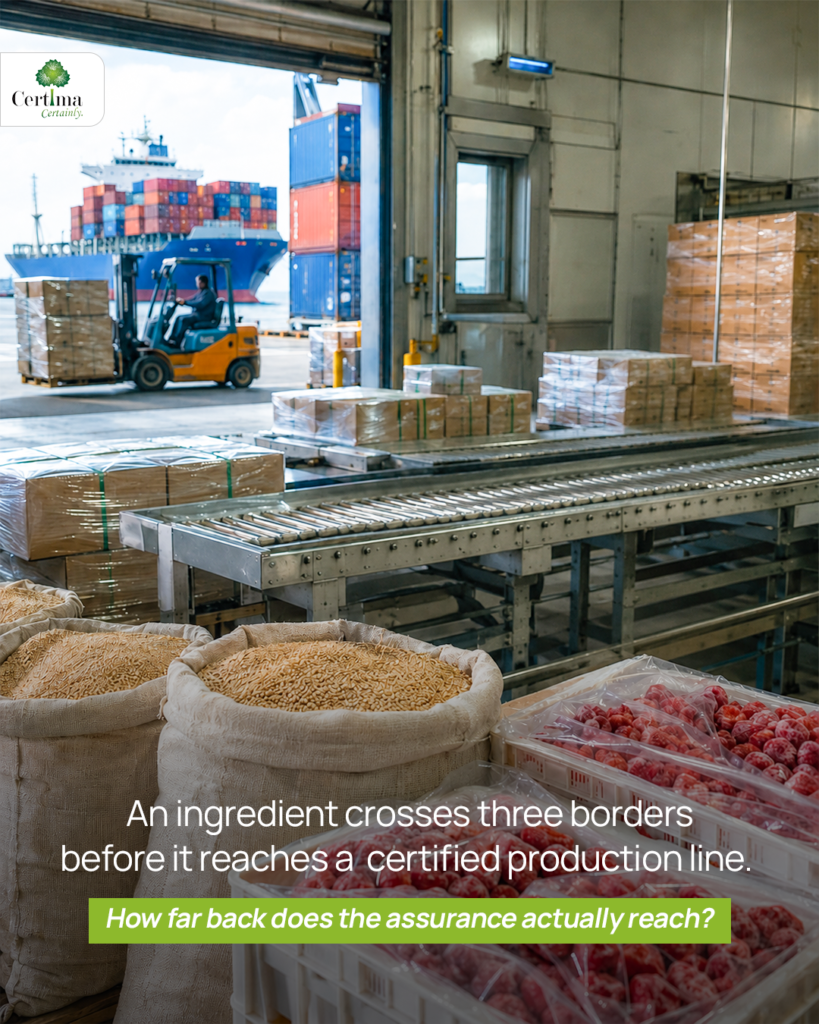
In August, Salmonella was detected in sesame seeds entering Europe from several origin countries, leading to recalls in Ireland and additional control measures elsewhere in the EU. In the same period, norovirus RNA was detected in frozen strawberries distributed across several European countries. In both cases, the products reached European supply chains through import routes…
Certima Blog
When an own-label product is recalled, a supplier made it. But it is the retailer’s name on the shelf.
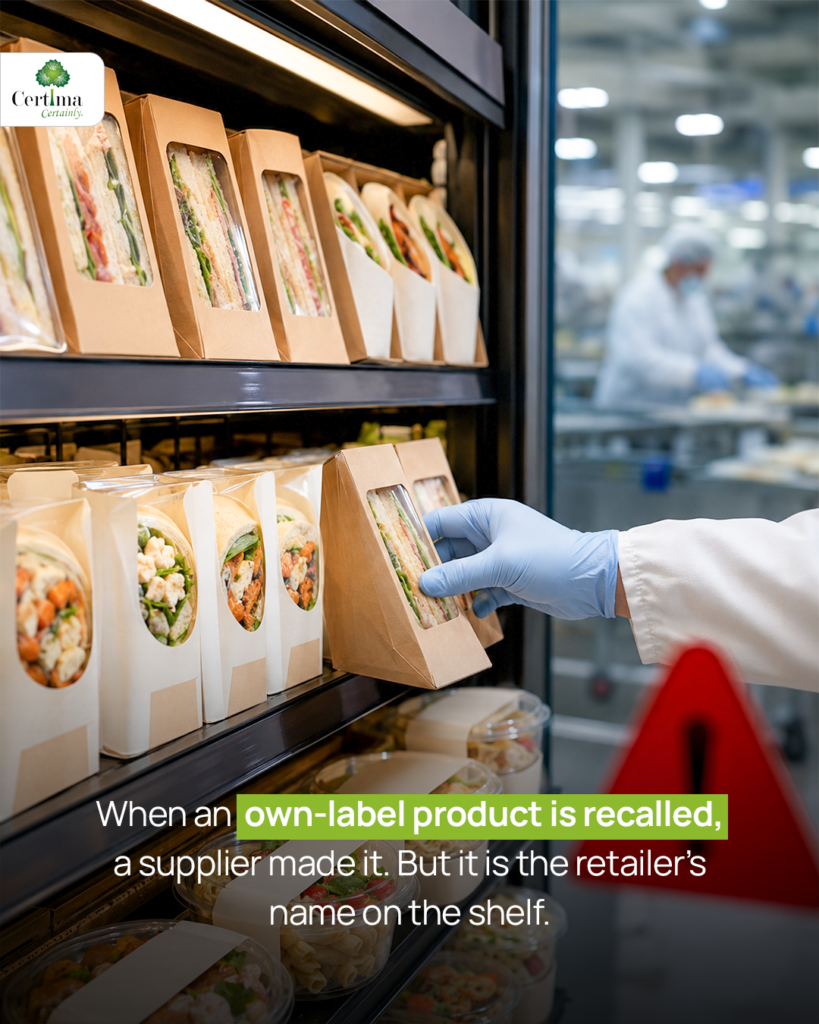
In August, several ready-to-eat own-label products were recalled in the UK over possible Listeria monocytogenes and E. coli contamination. Different products, different suppliers, separate incidents. What they shared was this: in each case, the name consumers saw on the recall notice was the retailer’s, not the manufacturer’s. Own-label products concentrate a particular kind of risk….
Certima Blog
A mock recall test looked complete on paper. It took four hours longer than it should have to actually trace the product.
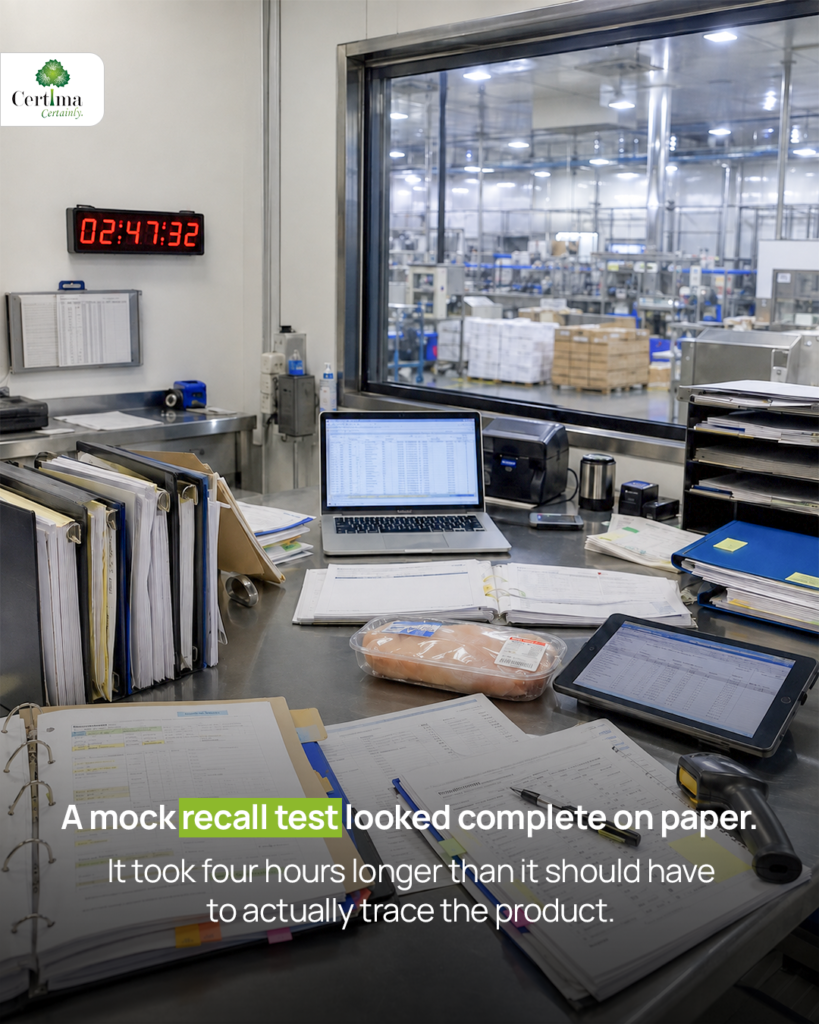
During a recent audit, a mock recall exercise revealed a gap that the facility’s documentation had not shown. The paperwork was in order, batch records existed, supplier information was filed, and the traceability procedure itself read as thorough. But when the exercise was run against the clock, tracing a single affected batch back through the…
Certima Blog
Losing a food safety certificate is rarely just a compliance matter. The consequences reach further than most companies anticipate.

Suspension or withdrawal of certification affects more than audit status. It can trigger immediate consequences across commercial relationships, regulatory standing, and internal operations simultaneously. Some consequences are visible and immediate. Others develop more slowly and are harder to quantify or recover from. What is consistent is that the pathway back to certification requires demonstrating genuine…
Certima Blog
A second-party audit and a third-party certification answer two different questions. Treating them as interchangeable can leave a real gap unaddressed.

Neither replaces the other. The risk lies in assuming they do, and in not being clear about which type of assurance a given relationship is actually built on. What comes in the way of clarity between the two Second-party and third-party audit results treated as equivalent evidence of compliance Buyers unaware of the accreditation status…

Certification audits provide a structured snapshot of system performance at a defined point in time. Between audits, food safety systems continue to operate, supply chains evolve, personnel change, and new risks emerge. The period between audits is where system consistency is either maintained or gradually eroded. Companies that treat certification as a periodic exercise often…
Certima Blog
One certification program, several facilities. Are they actually being assessed as a connected system, or as separate audits that happen to share a logo?

Multi-site certification programs are designed to bring consistency across an organisation’s facilities under a single framework. In practice, the value of that consistency depends entirely on how connected the assessment across sites really is. A facility in one region facing a specific seasonal risk, a different regulatory environment, or a distinct production process should not…