


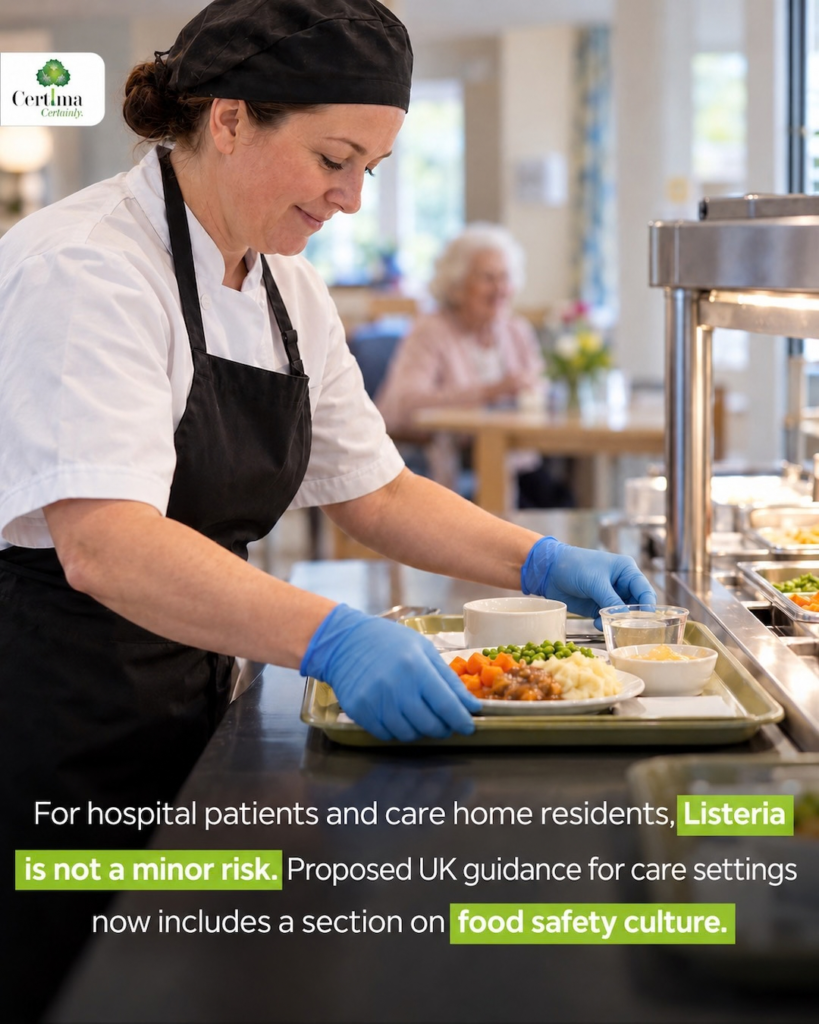
The UK Food Standards Agency has opened a consultation on revised listeriosis guidance for health and social care settings in England, Northern Ireland, and Wales. It is open until 16 December 2026. The draft clarifies legal obligations for food businesses in these settings, updates the list of foods considered risky for Listeria, and adds new sections on food safety culture and on incidents in the care sector.
The people served in these settings are among the most vulnerable consumers: older people, patients with weakened immunity, and others for whom listeriosis can be severe. For them, the margin for error is smaller than anywhere else in the food chain.
What stands out is the explicit place of food safety culture. It reflects a wider understanding across the sector: procedures define what should happen, but culture determines whether it happens consistently, especially when no one is checking.
What comes in the way of protecting vulnerable consumers
- Products supplied to care settings treated the same as products for the general public
- Listeria risk foods not clearly identified in specifications and supply agreements
- Food safety culture seen as a soft topic rather than a control factor
- Staff trained on procedures, but not on why vulnerable groups face higher risk
- Incidents in care settings not fed back to suppliers and manufacturers
When the consumer is vulnerable, every control carries more weight.
Audit-focused insights
From an audit perspective, protection of vulnerable consumer groups is evaluated through:
- Hazard analysis that considers the intended consumer, including vulnerable groups
- Specifications and controls for products known to carry Listeria risk
- Food safety culture activities and how their effectiveness is measured
- Staff understanding of risks linked to specific consumer groups
- Handling of complaints and incidents involving sensitive settings
Certima’s Mission
As an impartial certification body, Certima assesses compliance with international food safety measures. Certification enables businesses to demonstrate that they meet regulatory and client requirements for food safety and quality through rigorous compliance.
While Certima does not provide operational guidance, audits serve as a valuable tool for businesses to strengthen transparency and trust in the delivery of safe food products, while evaluating their food safety strategies and supply chain integrity.
Disclaimer This post references a public consultation by the UK Food Standards Agency. The guidance described is in draft and may change. It reflects general audit observations and does not constitute consultancy or operational guidance.
Source: Food Standards Agency, Food Safety News