


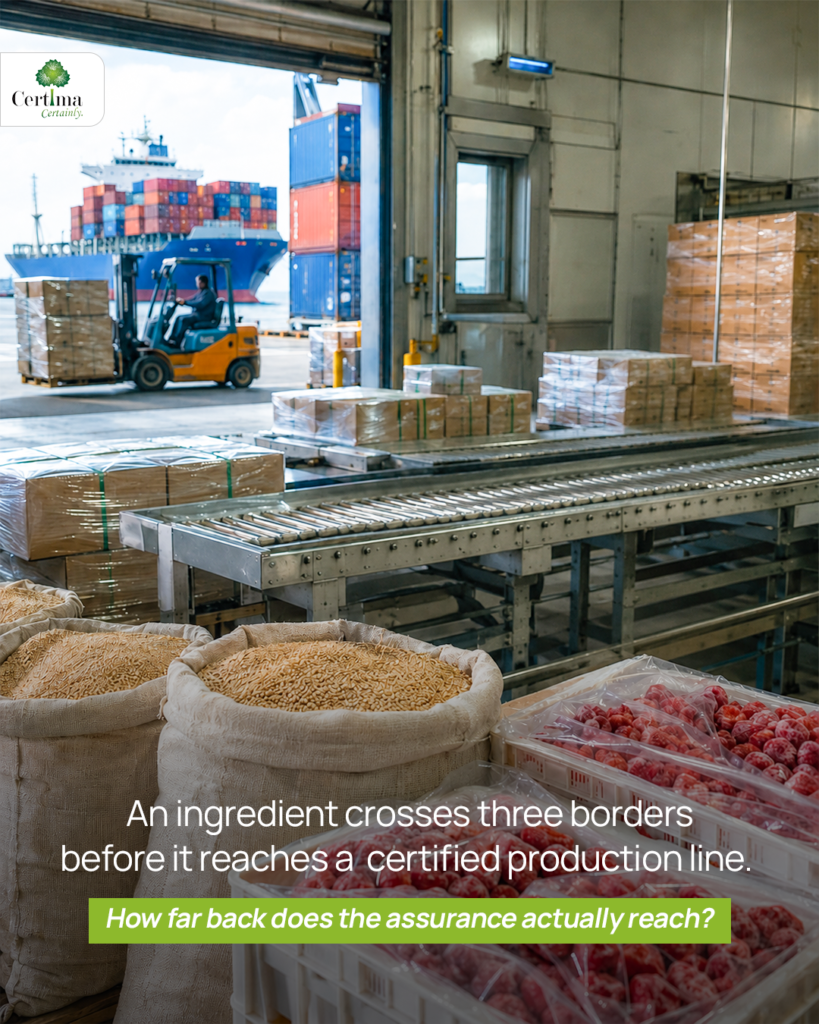
In August, Salmonella was detected in sesame seeds entering Europe from several origin countries, leading to recalls in Ireland and additional control measures elsewhere in the EU. In the same period, norovirus RNA was detected in frozen strawberries distributed across several European countries.
In both cases, the products reached European supply chains through import routes involving multiple countries, intermediaries, and handling stages. The facilities receiving these ingredients may themselves be certified and well run. The question these incidents raise sits earlier in the chain: how much is actually known about an ingredient before it arrives.
A certificate at the point of production covers what happens inside that facility. It does not automatically cover the journey an imported ingredient took to get there, or the controls applied at origin.
What comes in the way of upstream ingredient assurance
- Ingredient suppliers several steps removed from the certified facility, with limited direct visibility
- Import documentation confirming origin but not the controls applied at origin
- Assurance concentrated at the final production stage, thinner further up the chain
- Testing regimes not adjusted for ingredients with known contamination histories
- Intermediaries in the chain who handle product without transforming it, and receive less scrutiny
The further an ingredient travels, the more the assurance behind it depends on parties the buyer has never assessed.
Audit-focused insights
From an audit perspective, upstream ingredient risk is evaluated through:
- How incoming ingredient risk assessments reflect origin, route, and contamination history
- Supplier approval processes that reach beyond the immediate supplier where risk justifies it
- Verification activities, including testing, proportionate to the risk profile of the ingredient
- Traceability that can follow an ingredient back through intermediaries, not only to the last seller
- Evidence that import-related risks are reviewed when sourcing changes, not only at initial approval
Certima’s Mission
As an impartial certification body, Certima assesses compliance with international food safety measures. Certification enables businesses to demonstrate that they meet regulatory and client requirements for food safety and quality through rigorous compliance.
While Certima does not provide operational guidance, audits serve as a valuable tool for businesses to strengthen transparency and trust in the delivery of safe food products, while evaluating their food safety strategies and supply chain integrity.