


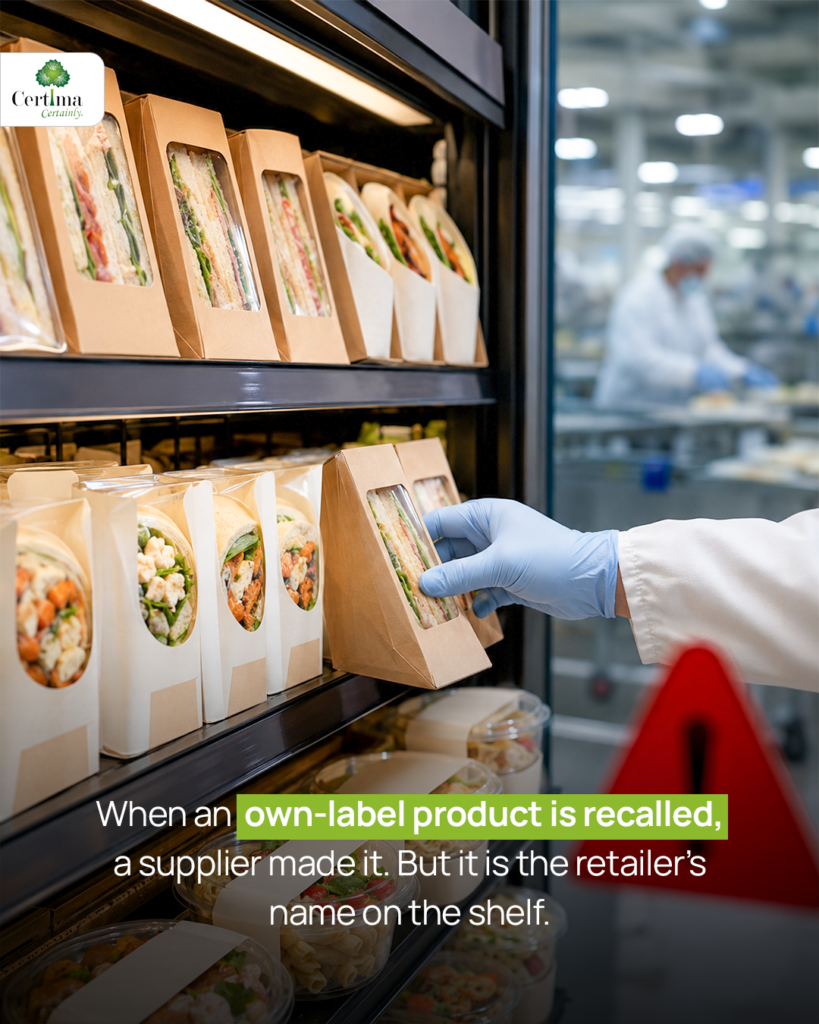
In August, several ready-to-eat own-label products were recalled in the UK over possible Listeria monocytogenes and E. coli contamination. Different products, different suppliers, separate incidents. What they shared was this: in each case, the name consumers saw on the recall notice was the retailer’s, not the manufacturer’s.
Own-label products concentrate a particular kind of risk. The retailer carries the brand exposure, the consumer relationship, and the regulatory attention, while the production itself happens inside a supplier’s facility the retailer does not directly control day to day.
This is precisely where the quality of supplier assurance stops being an administrative topic and becomes a commercial one. The strength of the audit behind an own-label supplier is, in practice, part of the retailer’s own brand protection.
What comes in the way of own-label assurance
- Supplier certificates accepted at face value without visibility into audit depth or findings
- Own-label risk treated the same as branded-product risk, despite the different exposure
- Audit frequency and scope not adjusted for products carrying the retailer’s own name
- Limited retailer visibility into how supplier corrective actions were actually closed
- Recall responsibility clear on paper, but assurance responsibility diffuse in practice
A recall notice does not distinguish between who made the product and whose name is on it. Consumers see one name.
Audit-focused insights
From an audit perspective, own-label supplier assurance is evaluated through:
- Audit scope that reflects the elevated brand exposure of own-label production
- Retailer access to meaningful findings information, not only certificate status
- Verification that corrective actions from previous audits were genuinely embedded
- Attention to ready-to-eat and high-risk categories where contamination consequences are most direct
- Consistency of assurance across an own-label supplier base, not only individual site checks
Certima’s Mission
As an impartial certification body, Certima assesses compliance with international food safety measures. Certification enables businesses to demonstrate that they meet regulatory and client requirements for food safety and quality through rigorous compliance.
While Certima does not provide operational guidance, audits serve as a valuable tool for businesses to strengthen transparency and trust in the delivery of safe food products, while evaluating their food safety strategies and supply chain integrity.