


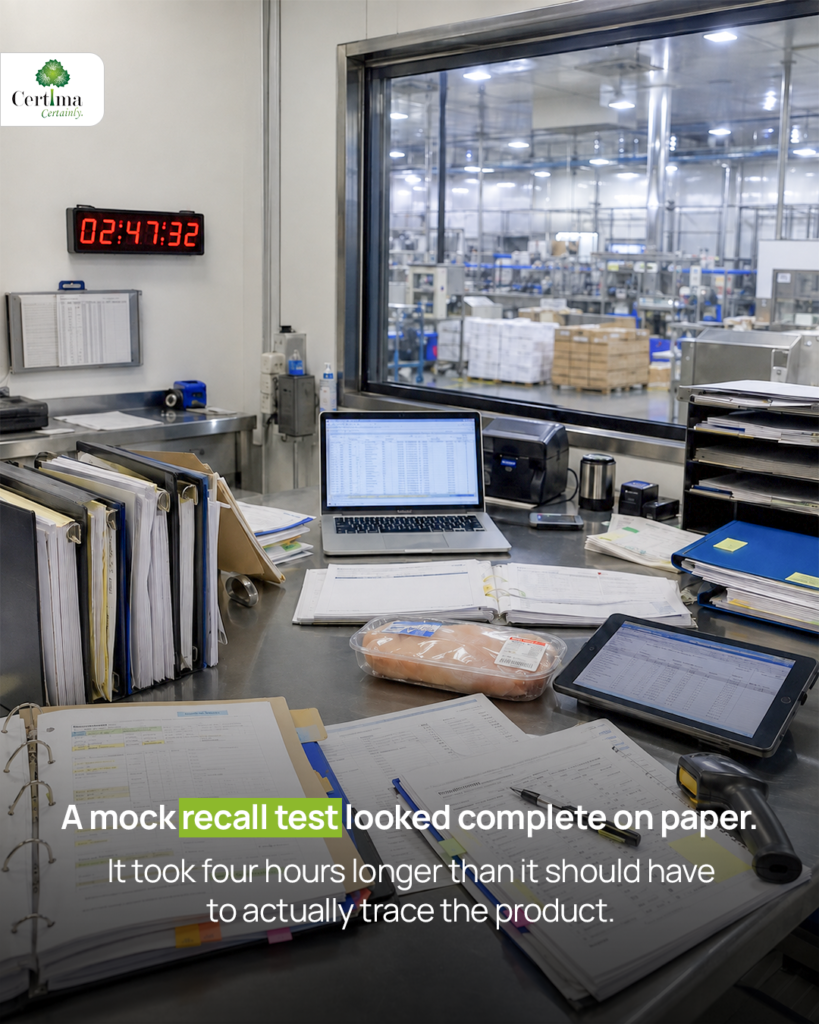
During a recent audit, a mock recall exercise revealed a gap that the facility’s documentation had not shown. The paperwork was in order, batch records existed, supplier information was filed, and the traceability procedure itself read as thorough. But when the exercise was run against the clock, tracing a single affected batch back through the supply chain took considerably longer than the standard allows for.
The delay did not come from missing records. It came from where those records lived, spread across different systems, some digital, some still on paper, with no single point where a full trace could be pulled together quickly. Each individual piece of documentation was accurate. Assembling them under time pressure was where the process broke down.
This is a common pattern. A system can look complete during a scheduled review and still underperform when tested the way a real recall would actually unfold.
What went wrong
- Traceability documentation spread across multiple systems with no consolidated retrieval process
- Mock recall exercises previously run without a strict time benchmark, so the delay had gone unnoticed
- Supplier-side documentation required a separate request rather than being readily accessible
- No single person or team responsible for pulling a full trace together end to end
Audit-focused insights
- A traceability system should be tested for speed, not only for completeness of documentation
- Consolidating trace-relevant records into a single accessible point reduces response time significantly
- Regular, unannounced mock recalls surface timing issues that scheduled ones tend to miss
- Supplier documentation accessibility should be tested as part of the same exercise, not assumed
Certima’s Mission
As an impartial certification body, Certima assesses compliance with international food safety measures. Certification enables businesses to demonstrate that they meet regulatory and client requirements for food safety and quality through rigorous compliance.
While Certima does not provide operational guidance, audits serve as a valuable tool for businesses to strengthen transparency and trust in the delivery of safe food products, while evaluating their fraud prevention strategies and supply chain integrity.