


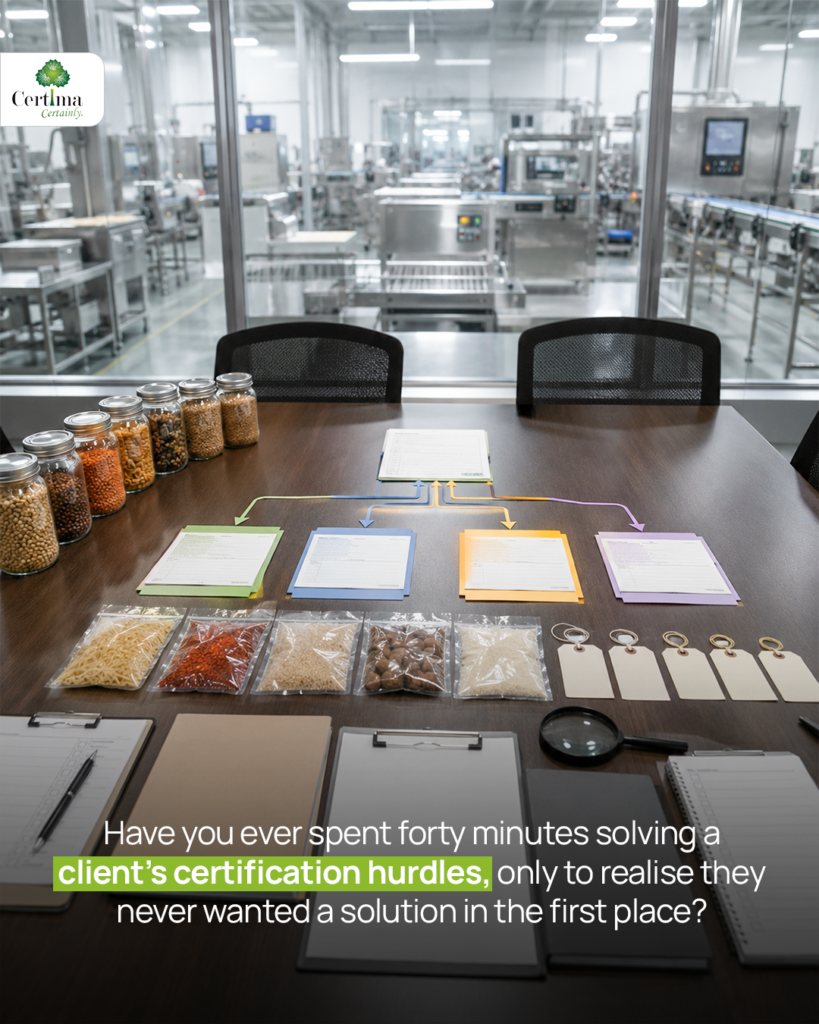
It happens more often than the certification sector likes to admit. A company reaches out, a standard process kicks in, requirements are listed, timelines are quoted, documents are requested. Forty minutes later, the company has answers to questions it never asked, and no answer to the one it came with.
Sometimes a company approaching a certification body is not looking for a certificate at all yet. They are trying to understand which standard fits their situation, whether their operation is ready, what their customers actually require of them, or whether certification is even the right step at this stage of their growth.
Those are different questions, and they deserve different conversations. A trading company weighing IFS Broker, a new food supplier preparing for a first IFS Food or BRCGS audit, and an established manufacturer reviewing whether their current standard still matches their customer base are not the same conversation with different names filled in.
What comes in the way of understanding a company’s actual need
- Standard processes applied before the actual question has been understood
- Certification treated as the assumed goal, when readiness or fit is the real question
- Companies guided toward what is easiest to deliver rather than what matches their situation
- Differences between standards, and between audit types, explained in technical terms rather than practical ones
- The stage a company is at, new, growing, or established, not reflected in the conversation
The right certification path starts with the company’s situation, not with the certification body’s process.
Practical insights
In practice, matching certification to a company’s situation involves:
- Understanding which standards the company’s customers actually require, which differs by market and buyer
- Recognising the differences between certification audits, supplier audits, and where each applies
- Considering the company’s operational stage, since a first certification and a renewal are different journeys
- Being clear about scope, so a certificate covers what the company’s customers expect it to cover
- Clarity about readiness, since an audit at the wrong moment serves neither the company nor the process
Certima’s Mission
As an impartial certification body, Certima assesses compliance with international food safety measures. Certification enables businesses to demonstrate that they meet regulatory and client requirements for food safety and quality through rigorous compliance.
While Certima does not provide operational guidance, audits serve as a valuable tool for businesses to strengthen transparency and trust in the delivery of safe food products, while evaluating their food safety strategies and supply chain integrity.